

 For the first time in its history, the 93rd SASTA Congress was held as a virtual event due to the on-going Covid-19 pandemic. There were 37 papers and 14 posters that addressed a wide range of industry relevant topics. The guest speaker was Dr John Pickering, a Behavioural Scientist from Evidn in Australia who showed delegates how behavioural science is being used in agriculture to facilitate the adoption of new methods and technologies.
A valuable review of the Biosecurity function in the South African sugar industry was presented. This paper highlighted how the centralised management of this function created advantages in standardised working conditions and survey methods, co-ordinated training, and employee development as well as opportunities for deployment across regions and for exchanging knowledge and skills.
Five papers focused on sugarcane grower development with a specific focus on small-scale growers. A Youth Empowerment programme saw 10 candidates placed by the South African Cane Growers Association in different sugarcane farms in the KwaZulu-Natal and Mpumalanga provinces of South Africa. A positive impact on skills transfer was realised and the findings can encourage the sugar industry, public sector and private development institutions to continue funding youth empowerment initiatives for the development of the country.
In Eswatini a study examined ways to reduce the productivity gap between large-scale and small-scale growers specifically using Information and Communication Technology (ICT) (especially mobile phones) to facilitate knowledge and information access among smallholder sugarcane farmers. The study showed that smallholder farmers are ready for the introduction of ICTs to improve information transfer among themselves.
Continuing with the theme of technology adoption results from an irrigation scheduling demonstration trial in the Pongola region of KZN confirmed that substantial benefits can be realised from accurate irrigation scheduling. Based on a survey after the trial, 65% of the respondents adopted a scientific scheduling tool (n = 100), a substantial increase from the 11% (n= 111) benchmarked in 2014.
Many Large-Scale Growers are diversifying out of sugarcane production due to ongoing sugar industry challenges that have impacted the returns in cane farming. Diversification, the costs thereof and the decision-making regarding diversification need to be understood in the sugar industry as it is an increasingly important trend, as it leads to financially sustainable growers. Results from a survey were presented that examined the opportunity costs of diversification.
The focus on economics continued with a paper that examined the impact of the Health Promotion Levy (HPL). In April 2018, the South African government implemented a new levy on non-alcoholic sugar-sweetened beverages (SSBs), named the Health Promotion Levy. This resulted in a significant decrease in demand for local sugar in South Africa. The paper presented an estimate of the financial impact of the HPL, specifically on sugarcane growers in South Africa, based on the preliminary 50% reduction in sugar sales to the SSB sector.
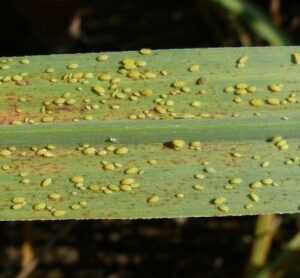
Yellow Sugarcane Aphid
Managing pests & pathogens is an integral part of sugarcane farming. A paper examined the efficacy of the mechanical harvester decontamination procedures recommended in the Australian sugar industry to reduce the risk of ratoon stunt (RSD) spread in the South African industry. Alternatives to the disinfectants currently being used in the South African industry were also tested. The Yellow Sugarcane Aphid (YSA) is becoming an increasing problem in the South African industry. Results presented from a study done on potted cane under controlled glasshouse conditions demonstrated that YSA has the potential to greatly reduce yields, especially when infestations occur in young cane. The study highlighted the likely severe economic impacts of YSA infestation on commercial sugarcane production in South Africa.
Initial results from a study using drone phenotyping of key plant traits suggested that drone captured normalized difference vegetation index (NDVI) and canopy temperature (Tc) of stress-free crops before canopy closure could be used to identify high-yielding genotypes. This work shows promise that drone phenotyping could enhance sugarcane breeding.
The final agriculture session of congress comprised of papers focused on soil health and nutrition. A review of soil conservation systems used in the sugarcane industry over the last 50 years showed that soil erosion is an ongoing issue, and the sugarcane industry needs to have a continuing focus on minimising loss of valuable topsoil from sugarcane fields. Awareness of soil erosion must be raised and should be accompanied by guiding best practices to remediate and mitigate the effects of erosion.
One of the major cost drivers in sugarcane production is fertilisers and farmers could reduce the cost of fertilisation by considering other sources of nutrients such as cane residues. A study evaluated the nutritional content of dry and green leaves, stalks and tops of 14 different varieties grown in Zimbabwe. The results showed that sugarcane residues contain significant nutrients that can be used to supplement inorganic fertilisers and thus reduce the amount of fertiliser applied to the soil.

by Deborah Sweby
SASTA Council Member
Resource Manager: SASRI Crop Biology Resource Centre