The Sugar Milling Research Institute NPC (SMRI – Non-Profit Company) arranged a workshop on the application of 4th Industrial Revolution (4IR) principles and technologies to the sugar industry, with an eye to assisting the industry to regain lost performance. The SMRI is developing appropriate technologies for the industry as part of the Sugarcane Technology Enabling Programme – Sugar Factory 4.0 (STEP-SF4.0). This Programme is Funded by the sugar milling industry and the Department of Science and Innovation’s Sector Innovation Fund, plus SMRI in-kind contributions, to the value of R20 million. It commenced in March 2019 and scheduled to be complete in March 2022.
Dr Lidia Auret of Stone Three presented an overview of 4IR technologies and applications, with examples of how the technologies have been applied in the mining industry. These include smart sensors, image analysis and machine learning models that can provide rapid analysis of process conditions and predictions of imminent out of specification process conditions.
Steve Davis of the SMRI gave an overview of the STEP-SF4.0 Programme and its projects. Each project was designed to address a particular factory problem area or source of poor performance and bring 4IR technologies, including new sensors and real-time process modelling into the factory to provide more relevant information to operating staff to enable improved decision-making. He outlined two pilot projects underway in 2021 as follows.
• Diffuser operations. This project developed a diffuser model that collects data from an operating diffuser, and includes the use of new instruments and sensors developed during the project. This is processed in a machine-learning model to predict sucrose extraction and other diffuser performance measures in real time. The information produced can inform operators to make changes in setpoints to improve performance, or ultimately can be linked to a model predictive controller to automate operation.
• C-station operation. The majority of sucrose loss in a factory occurs to final molasses, but this is affected by a multitude of factors throughout the boiling house. The project aimed to develop a C-station performance tracking simulator that ingests process data from the entire boiling house and specific inputs from C-continuous centrifuges to a machine-learning model. This model predicts the sucrose loss to molasses in real time and alerts operators to unfavourable process conditions that would lead to high losses.
Dr Kitty Foxon of the SMRI described a project to develop a live dashboard showing sources of energy (steam) consumption in a sugar factory, based on various process and energy measurements that are available. The model-based dashboard enables users to interrogate multiple derived variables over chosen time periods and compare current operation to previous best operating periods, using the data envelopment analysis technique, to determine the previous best energy efficiency under those or similar conditions. The dashboard has now been implemented at a local sugar factory and underwent testing during the 2021 crushing season.
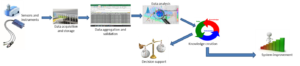 John Atherfold of Opti-Num Solutions presented an overview of a STEP SF4.0 project to manage process bottlenecks in a local sugar factory. A model predictive controller was devised and implemented using real-time process data to (1) optimise imbibition addition to balance extraction and energy demand for the evaporators and (2) manage cane crush rate to ensure that the syrup tank always has sufficient syrup to feed the A-pan station, which is a factory bottleneck. The second outcome has been implemented in the factory and has been shown to work well. It is now being tested using automatic control of the feed rate.
Yolanda Mbuthuma of the SMRI described three sensor development projects being undertaken by the SMRI at local factories.
• Cane preparation sensor. Incoming cane quality can vary quite rapidly and behave differently to settings of the preparation equipment, and this may have adverse effects on sucrose extraction performance in diffusers. This project uses a camera mounted over the shredded cane conveyor to capture images of the cane at 1 second intervals. Image processing software identifies features that can be associated with the degree of cane preparation and extraction behaviour which are correlated with conventional measurements of cane characteristics to train the model to classify prepared cane quality.
• C-centrifuge camera. This project uses a high-speed camera and lighting system to produce real time images of the sugar and molasses flows within a factory C-centrifuge to facilitate adjustment of wash water and steam for maximum recovery. From the images, operators will be able to safely detect any abnormal conditions in the basket such as uneven feeding, incomplete washing and damaged screens. Early detection of such enables quick action to be taken before excessive losses are incurred.
• Juice distribution sensing. Control of the level of juice at various stages of a diffuser is very important to achieve the best possible extraction. A conductance sensor system has been developed by the SMRI and installed in a window of a diffuser at a factory to detect both cane and juice levels and display these to the operator in real time.
Paul Sikhakhane of Mzukulu Technologies outlined some of the hardware and software considerations involved in implementing 4IR projects in industrial operations. He noted that the complexity of systems and legacy hardware and software installations often made smooth implementation of 4IR projects fraught with difficulties and emphasised the vital need for early communication between all involved parties and proper mapping of the systems.
Ivan Voigt, an SMRI Associate, presented a summary of various sensors that are available in the commercial market that have potential applications in the sugar industry, including process control, fault identification, condition monitoring and maintenance scheduling tools. Many of the sensors and systems available are ready to interface with popular data management and control systems in factories.
 The workshop was well attended (153 attendees) from a diversity of organisations and well received by the audience. It was considered to have succeeded in its objective of raising awareness of the applications and benefits of 4IR technologies to the South and southern African sugarcane processing industries and in particular the projects being undertaken at South African factories by the SMRI and collaborators under the flag of STEP-SF4.0.
By Steve Davis
SMRI R&D Manager